
A business contract lawyer helps companies create, review, negotiate, and enforce agreements that define their rights and obligations. They identify legal and commercial risks, clarify important terms, and help businesses address disputes when contractual commitments are not met.

What Does a Business Contract Lawyer Do?
Business contracts can affect revenue, ownership, operations, intellectual property, and long-term relationships. Legal counsel can help ensure an agreement reflects the actual business arrangement rather than relying on language that may not fit the transaction.
Contract Drafting
Drafting is more than filling in names and dates on a standard form. A business contract lawyer structures the agreement around the actual transaction, defines each party’s responsibilities, establishes payment and performance terms, and addresses what happens if circumstances change. A well-drafted agreement should make important obligations clear while anticipating foreseeable problems, including delays, non-performance, confidentiality concerns, and early termination.
Contract Review

A contract may look reasonable while containing provisions that create significant exposure. A contract review lawyer examines definitions, obligations, deadlines, renewal provisions, indemnification, confidentiality, intellectual property, liability, termination, and dispute provisions. The goal is to understand not only what the agreement says, but also what it could require the business to do later.
Contract Negotiation
Strong agreements often result from careful contract negotiation rather than simply accepting the first draft. Legal counsel can identify provisions that should be revised, explain the practical consequences of proposed language, and help negotiate terms that better align with the client’s commercial objectives.
Contract Enforcement & Dispute Resolution
When a party fails to perform, counsel can assess the agreement, available remedies, notice requirements, and dispute-resolution procedures. Depending on the circumstances, the matter may be resolved through negotiation, mediation, arbitration, or litigation.
Common Types of Business Contracts a Lawyer Handles
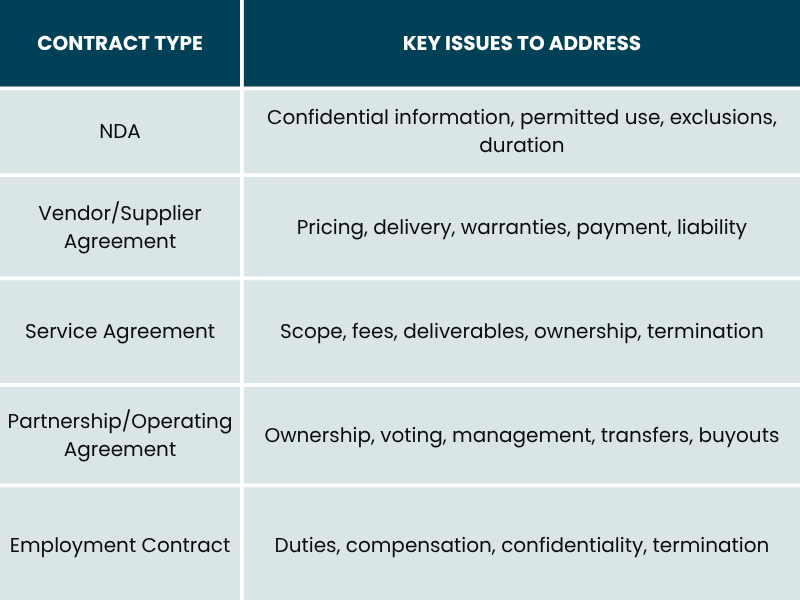
Businesses use contracts throughout their operations, from protecting confidential information to defining relationships with owners, employees, customers, and suppliers. A business contract attorney may assist with agreements such as:
Non-Disclosure Agreements (NDAs)
An NDA (non-disclosure agreement) protects specified confidential information from unauthorised use or disclosure. It should define what information is protected, permitted uses, exclusions, obligations after disclosure, and the consequences of a breach.
Vendor & Supplier Agreements
These agreements can establish pricing, delivery requirements, quality standards, payment terms, warranties, insurance obligations, and procedures for handling delays or defective goods.
Service Agreements
Service contracts should clearly describe the scope of work, deliverables, fees, timelines, client responsibilities, ownership of work product, confidentiality, and termination rights.
Partnership & Operating Agreements
For businesses with multiple owners, these agreements can address contributions, management authority, voting, distributions, transfers, buyouts, and what happens when an owner leaves or disagreements arise.
Employment Contracts
Where appropriate, employment agreements can define compensation, duties, confidentiality, intellectual property, restrictive covenants, termination terms, and other employment-related obligations, subject to applicable law.
What Makes a Contract Legally Enforceable?
Although contract law varies by jurisdiction and circumstances, a basic agreement generally requires these elements:
-
Offer: One party makes a definite proposal.
-
Acceptance: The other party accepts the proposal as required by law.
-
Consideration: Each side gives or promises something of legal value.
-
Capacity: The parties have the legal ability to enter the agreement.
-
Legality: The agreement concerns a lawful purpose.
A written agreement can still raise enforceability questions if its terms are ambiguous, required formalities are missing, or other legal requirements apply. A lawyer can assess whether the particular agreement is likely to constitute an enforceable contract under the applicable law.
Signs You Need a Business Contract Attorney (Not Just a Template)
A template may be useful for straightforward, low-risk arrangements, but professional review becomes more valuable when a business contract lawyer can also help you assess whether the document actually matches the commercial deal you intend to make:
-
The transaction involves substantial money or long-term obligations.
-
The agreement creates a recurring business relationship.
-
More than one state or jurisdiction is involved.
-
The deal includes unusual or significant liability exposure.
-
The other party has its own lawyer negotiating the terms.
-
The contract involves intellectual property, confidential information, ownership rights, or complex performance obligations.
Business Contract Review Checklist: What an Attorney Looks For
For complex arrangements, a business contract lawyer can review the agreement as a whole rather than evaluating each clause in isolation.
Indemnification Clauses
Indemnification provisions determine when one party may have to cover certain losses, claims, or expenses involving the other. The scope, triggers, exclusions, procedures, and relationship to insurance and liability caps deserve close attention.
Termination Clauses
Termination clauses explain when and how an agreement can end. Counsel may examine termination for convenience, termination for cause, notice periods, cure rights, post-termination duties, and the treatment of outstanding payments or confidential information.
Liability Limitations
A liability provision can materially affect the financial consequences of a dispute. Review should consider the liability cap, exclusions from the cap, consequential or indirect damages, and whether the allocation is consistent with the transaction’s risks.
Dispute Resolution & Governing Law Clauses
These provisions can determine where and how disputes are handled and which jurisdiction’s law applies. A carefully drafted clause can reduce uncertainty over procedure, venue, and applicable legal rules.
What Happens When a Business Contract Is Breached?
A breach occurs when a party fails to perform a contractual obligation without a legally sufficient excuse. The appropriate response depends on the agreement, the nature of the breach, and applicable law.
Potential remedies may include damages intended to compensate for qualifying losses, specific performance requiring a party to perform an obligation in appropriate circumstances, or rescission, which can unwind a contract when legally available. Before taking action, review notice requirements, cure periods, limitation clauses, and dispute procedures. Preserving relevant records and obtaining legal advice early can also help a business understand its available options.
Business Contract Lawyer vs. Online Templates: What You Risk by Skipping Legal Review

Online templates can provide a starting point, but they generally cannot account for the specific transaction, bargaining position, industry requirements, or risk allocation involved in a particular deal. A business contract lawyer can tailor provisions and identify issues that a generic document may leave unresolved.
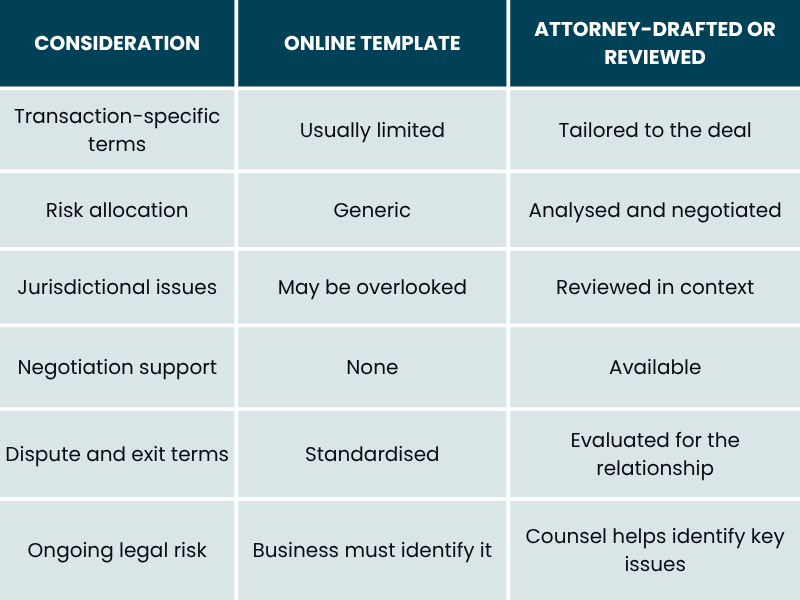
The right choice depends on the contract’s complexity and risk. Working with a business contract lawyer can be particularly useful when the agreement will shape an important customer, supplier, ownership, or strategic relationship.
Minimizing Business Liability Pre-Signature
A business contract lawyer can help a company move from generic language to an agreement that clearly reflects the transaction, allocates risk, and provides a practical path forward if problems arise. Professional review is especially valuable when the contract involves significant financial exposure, long-term commitments, complex ownership issues, or another party’s legal counsel.
Ready to review a business agreement before you sign? Explore the Law Offices of Suzanne E. Rogers’ Corporate & Business Law services or schedule a free contract review consultation to discuss your agreement and your business objectives.